1850-1860
Hancock County and its "Golden Decade"

This “golden decade” was supported by the fact that in the history of slave societies the way the institution of slavery was practice in the American South actually reproduced upon itself.
For instance, by 1860 the enslaved population in the American South comprised an increase of more than 4,000,000 descendants of people from the African continent. A virtually inexhaustible source of free and skilled labor.
During the I850’s, when the new agricultural practices in the area were reaching a high degree of efficiency, there was a considerable movement of white people from the county. Many of these emigrants were landless farmers,” some were small landowners without slaves, and a few were small slaveholders. As the white population thus diminished, there was an increase in the number of slaves, a concentration of landownership, and a rise in land values.1
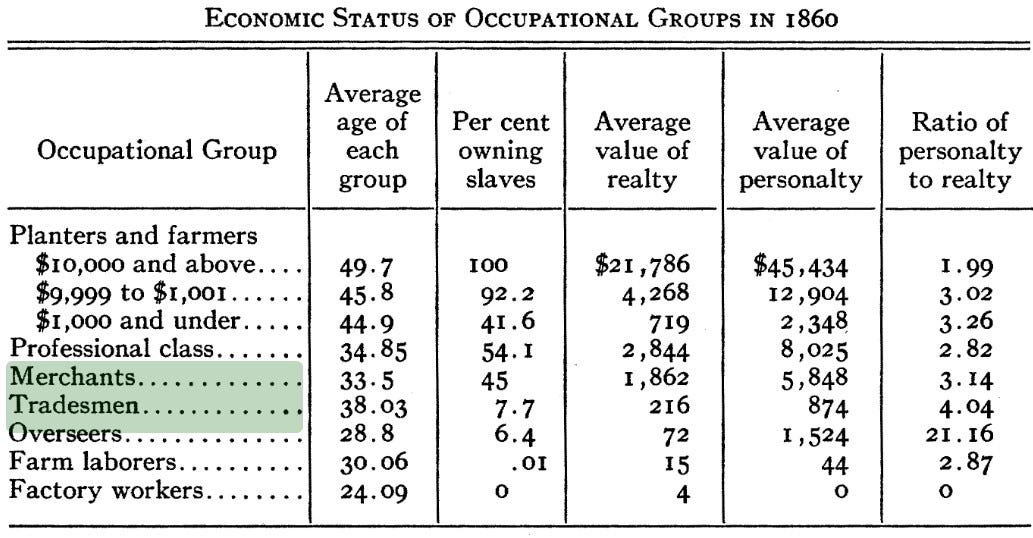
Bonner’s analysis, in which Hancock County was its sole sample demonstrates that the period between 1850-60 might be the most promising when attempting to identify black tradesmen in the county. Tradesmen in Hancock county Bonner explains, are categorized in a professional class of citizenry. Even so, Bonner expands upon the domestic realities of tradesmen overlapped with the unmarried factory laborer who lived generally with the families of tradesmen; might some of these unmarried workers be enslaved males?
From Bonner:
Of the 8,137 slaves in the county in 186o, over 96 per cent were in the hands of agricultural groups, including nine overseers and two farm laborers. The 302 slaves belonging to the non-agricultural group were widely distributed in all categories of this group, the factory workers being the only class where no instance of slave ownership appeared.
The non-agricultural slave owners included eight merchants, three non-farming physicians, two non-farming attorneys, three teachers, two carpenters, a wagoner, tanner, coachmaker, blacksmith, clerk, druggist, and the county sheriff. Nancy Wadkins, a free Negro, owned two slaves.2
With only two carpenters in the non-agricultural slave ownership group. I will need to find out who these men were, it is most likely that their slaves were also skilled tradesmen who may have been responsible for the constitutions of the many grand homes built during the “golden decade”.
James C. Bonner, “Profile of a Late Ante-Bellum Community".” p.666
Bonner, p. 674